honjima.com

Greeting

January 1, 2026 (Tenrikyo 189)
New Year’s Greeting

Happy New Year!

Rev. Kanta Katayama
Honjima Grand Church Head Minister

Rev.KatayamaKanta

(Summary)

Happy New Year!

Thank you so much for exerting efforts for single-hearted salvation in the previous year by raising the awareness of being Oyasama’s instruments.

This year is the year of Oyasama’s 140th Anniversary.

So that we can savor joy and a sense of accomplishment through the progress you made during “three years, one thousand days,” let us continue all the way to the end to achieving the spiritual resolution(s) made, even if you may fall short from accomplishing.

Whether or not you are able to return to Jiba on the day of the Anniversary, let us be thankful for the parental love of the everliving Oyasama, and let us also pledge with each other to take on the task of universal salvation in high spirits and with big heart, just like how Oyasama withdrew from physical being to level the ground of the world on the lunar-calendar date of January 26, 1887.

Please allow me to ask for your continued support cheerfully and joyfully in unity of mind.

(Edited by Honjima Tsushin Editorial Staff)

Monthly Sermon

December 22, 2025 (Tenrikyo 188)
Honjima Grand Church Monthly Service Sermon

“Let us engage in Missionary and Salvation Work in High Spirits, Using Oyasama’s Divine Model as the Dependable Guide.”

Rev. Kuniaki Hasegawa
Honjima Grand Church Board Member

Rev.hasegawaKuniaki

(Summary)

I would like to extend my heartfelt congratulations for completing the last monthly service of the year with Rev. Katayama as the core.

Regarding the parental love of Oyasama, the following is in the Instruction Four:

“On the lunar-calendar date of January 26, 1887, Oyasama withdrew from physical life by shortening Her term of life in order to hasten the spiritual growth of all humankind, Her children. Yet, She remains everliving at the Residence of Origin, providing Her workings and guidance at the forefront of world salvation.”

To respond to Oyasama’s parental love, we have been exerting our efforts for the past three years to bring joy to Oyasama, aiming toward the 140th Anniversary of Oyasama, which will be observed on January 26, 2026.

The time goes by, and there is no end to its flow.

I became a head minister when I was 30 years old, and three years later, I observed the 90th Anniversary of Oyasama. This 140th Anniversary of Oyasama will be the sixth anniversary that I will have observed. It is a seasonable time to bring joy to Oyasama by making progress in our spiritual growth in unity of mind, aligning our minds with the Instruction Four that was announced for this Anniversary. The path to the Joyous Life, however, will continue endlessly, even after Oyasama’s 140th Anniversary.

Some of you may have achieved your spiritual resolutions, and some of you may still be trying, but we have one more month to work on the spiritual resolutions and grow spiritually to bring joy to God the Parent and Oyasama. I think this is a goal that we all share.

There is a Japanese idiom, “fueki ryuko,” which translates to “consistensy and change.” This is a concept Basho Matsuo acquired during his trip in “The Narrow Path to the North,” and it means that in order to be consistent, change is necessary, and in order to change, one cannot ignore consistency—the root is the same.

As we welcome the new year, I don’t think I am the only one who feels the breath of life and the arrival of the beginning, praying many new buds to sprout on trees that showed no change until yesterday.

In the Instruction Four, it says:

“‘Buds sprout from knots,’ She encouraged those around Her by saying that whatever happens is God’s arrangement for guiding people to spiritual maturity.”

I hear that people in Japan this year are going through a difficult time because of the rice price surge. In the path of Oyasama’s Divine Model, after Oyasama became the Shrine of Tsukihi, She gave away everything in the Nakayama Family to “plunge into the depths of poverty.” After 16 years has passed, when Kokan informed Oyasama “there is no rice left in the house for tomorrow.” Oyasama said to Kokan, “In this world there are those who are suffering, unable to eat or even to swallow water despite food piled high at their bedsides. If we think of them, how blessed we are, for when we drink water, it tastes of water. God the Parent has blessed us with exquisite gifts. However wretched you may be, never say you are wretched. For I shall never make beggars of you.” Oayasama gave warm words of encouragement and went through such circumstances with the mind of joyous acceptance.

Also in the Instruction Four, we read:

“‘When you drink water, it tastes of water.’ She taught us to always feel a sense of gratitude for the boundless blessing of God the Parent in any situation as we walk the path,” and I am very grateful for this.

After the war, my family of six had no place to go in the scorched wasteland of Hiroshima, so we lived for several years in my father’s friend’s cattle shed. Our meals were barley, daikon radish, and sweet potato porridge every day. Several years later, when I spent New Year’s at a relative’s house, I was able to have white rice for the first time, I still remember feeling thrilled as a child, thinking, “Wow, I get to eat silver rice!”

I became life-threatening ill when I was in college but made a full recovery. After being told by the doctor, “You were miraculously saved by god in heaven,” I decided to quit college and made a resolution to follow the path.

While my wife and I were serving at Honjima Grand Church as live-in staff, we wanted to experience the Divine Model of Oyasama, even if only a little. So, with the permission from the 3rd grand church head minister, Rev. Toshitsugu Katayama, my wife and I set out to conduct missionary work away from our own church. At the time, I was 27 years old, and my wife was 24.

Both my wife and I were still beginners in the faith. We had only just learned the “Sacred Names given to the Ten Aspects of the Complete Providence” and the “Eight Dusts,” and even while relying on Oyasama’s Divine Model, we really didn’t know how we should convey the teachings to others. With that, we got off at Nakatsu Station.

We immediately thought about going out to spread the fragrance of the teachings, but since we were in an unfamiliar place with nowhere in particular to go, we asked a passerby to tell us where a nearby Shinto shrine was. We climbed the steps, looked out over the town below, and while talking about where we should begin our efforts, we eventually said, “It’s already late, so let’s sleep at this shrine tonight and begin our missionary work tomorrow.” Just then, we heard rustling sounds and sensed someone’s presence, which made us feel uneasy, so we decided to leave the shrine and walked along a road in the village. That was when a woman called out to us, saying, “You don’t look like people from around here. Do you have some business here?” We answered, “We are Tenrikyo missionaries. We just arrived here, but we have nowhere to stay and don’t know where to go.” She kindly replied, “That must be inconvenient. If you’d like, you may use the storage shed at my house,” and thus a place to sleep was settled. We truly felt the wondrous workings of God the Parent and Oyasama.

The next morning, the two of us immediately went out to spread the fragrance of the teachings. I said, “from today, I’m going to fast,” and my wife replied, “then I will, too.” However, by the next day, she broke out in a cold sweat and was crouching down in exhaustion. I wondered if perhaps she might be pregnant, so I bought her a snack bread and had her eat it. This still remains a dear and nostalgic memory for me.

As we continued walking from place to place spreading the teachings, we eventually came to what looked like an elderly care facility. There we met an elderly person who had been bedridden for a long time. When we administered the Sazuke, the smell of excrement and urine was terrible, as if the bedding had not been washed for many days, and the room was filthy, so we were allowed to clean it as well. However, the stench was so overwhelming that at one point my wife couldn’t bear it and had to step outside.

Perhaps out of concern for my wife and me, as we were spreading the fragrance of the teachings without much experience or understanding, Rev. Toshitsugu Katayama sent us a letter asking us to return, and so we resumed our service at the grand church as live-in staff. As we had made a firm resolution to follow the path, we were filled with enthusiasm to tackle any task that was presented to us, hoping to experience even 1/10,000 of Oyasama’s Divine Model.

After completing our service as live-in staff, we received an appointment from Rev. Katayama to become the successor of the N.C. Church based in California, and we moved into the church to begin our life there.

I was embarrassed by doing missionary work; I didn’t fully understand the teachings and above that, conveying them in English was difficult for me. I was turned down and was yelled at, “Be quiet! Get out of here!” I was also told by zealous Christians who chased me down to convert me saying, “Your religion is a cult. Hurry up and open your eyes. You must believe in Christ.” To those people, I couldn’t say anything and I just continued to walk.

At one house, a dog barked at me and even bit my leg. Each time, I composed myself again and continued missionary work, but I wasn’t able to convince anyone with the teachings. At that point, I was so done with it. The internal hesitation and conflict within me continued and I was on the edge into depression.

At that time, I was inspired by the words of God:

Always ridiculed and slandered,
Still I will realize remarkable salvation. (Mikagura-uta, III:5)

Do not grieve over whatever path you are now on.
Take delight in the main path that lies ahead. (Ofudesaki III:37)

In the Instruction Four, we are taught,

“‘Through saving others, you will be saved.’ Oyasama taught that, if we remain singly focused on working for the salvation of others, our minds will gradually become purified without us even realizing it and will allow us to be saved and be filled with joy and brightness.”

At the time of the 100th Anniversary of Oyasama, I had some troubles brought upon myself due to a large debt that I had taken on. In order to experience even a little of the Divine Model of Oyasama, I made a spiritual resolution to quit drinking and smoking.

In the past, the Shinbashira gave us these words in his Spring Grand Service sermon.

It goes without saying that the purpose of studying the teachings is not merely to know them but actually to implement them. We study the teachings to internalize them so that we can live each day in a manner based on the teachings. It is far from easy to become single-hearted with God or to come into complete accord with God the Parent’s intention. Nevertheless, our work toward achieving spiritual growth entails seeking the heart of the Parent constantly and making repeated efforts to near God’s intention.

Unless we are careful, we humans can get caught up in our self-centered imaginations, lose sight of the Parent, and even turn our backs on the Parent. In all matters, therefore, we should make a point of seeking God the Parent’s intention and asking ourselves what Oyasama would do in any given situation; we should always ponder and act in light of the Divine Model as well as of the teachings, which should serve as the yardstick.

This will shape whether or not the decisions and choices we make at important junctures such as life’s crossroads and turning points are in accordance with God’s intention. I believe that we will certainly find ourselves enabled to know which direction to take if we purify our mind and seek out the path to accord with the divine intention based on the teachings.

Living as we do in this day and age, I am sure we sometimes face dilemmas and difficult decisions that our predecessors never had to deal with. At such times, we can base our ponderings on the following Divine Direction:

Sah, sah, because Tsukihi exists, the world exists. Because the world exists, things exist. Because things exist, your bodies exist. Because your bodies exist, law exists. Although the law exists, to resolve your minds is primary. Osashizu, January 13, 1887

For the 110th Anniversary of Oyasama, I made the spiritual resolution to return to Jiba every month from America and continued for 12 years. As I contemplated “What is the pilgrimage to Jiba?” I struck upon the idea to conducting water purification and then dancing the Twelve Songs of the Service in front of Oyasama’s gravesite for a year. Summer is fine, but the pain from water purifications in the middle of winter were so intense that it felt like I was having my flesh cut open.

Although I am still inexperienced, I went through these, hoping to experience even a little of the Oyasama’s hardships, and after visiting the Foundress’s Hall, a deep sense of gratitude for being guided back to Jiba welled up within me. At that point, I felt I was able to find the answers that addressed my various worries. I don’t know exactly what is, but when I sit alone before Oyasama, it strangely removes many of my anxieties. My heart becomes calm and peaceful, and I feel like I receive energy.

Furthermore, I was doing hinokishin like pulling weeds at church headquarters, Honjima Grand Church, and the followers’ dormitory, as well as doing missionary work during the day.

I shall let you work by the truth of you mind. One person can face myriads solely by virtue of the mind. God rides on the mind and works. As long as the mind is firm, God will ride the mind and work freely and unlimitedly.
(Osashizu: October 2, 1898)

In 1881, when the stone for the Kanrodai was being transported from Takimoto Village, the cart stopped moving when it reached the gate of the Residence. At the very moment, Oyasama appeared from Her room and shouted, “Yoisho!” and upon hearing Her voice, everyone pushed together with all their might and the cart rolled in easily. Everyone was deeply moved by Oyasama’s solemn and inspiring presence at that time, as described from Story 82 of the Anecdotes of Oyasama, “Yoisho!”

This is an episode that allows us to vividly picture the scenes of those days. Especially during this particular season, as we approach the Anniversary of Oyasama, the divine image of Oyasama should provide every Yoboku the courage to take that next step in every aspect of our lives. At this very moment, regardless of whether we are consciously aware of it or not, Oyasama is calling out to our hearts with a powerful and encouraging “Yoisho! (Heave-ho!).”

Let us make a mutual pledge to bring as many people as possible back to Jiba, and let us go through each day relying on the Divine Model of Oyasama.

Thank you for your kind attention.

(Edited by Honjima Tsushin Editorial Staff)
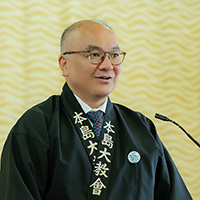
Greeting

November 22, 2025 (Tenrikyo 188)
Head Ministers’ Meeting

Let us advance harmoniously and united in mind.

Rev. Kanta Katayama
Honjima Grand Church Head Minister

Rev.KatayamaKanta

(Summary)

I use a handmade cushion during morning and evening services. It is because I hurt my knee from getting too excited at the time of the previous Shidokai Besseki Group Pilgrimage. Ever since then, it goes back and forth between getting better and getting painful. There were times when I was not able to be in high spirits as the recovery is taking time.

In the beginning of the Instruction Four, the Shinbashira states, “in the hope that they will serve to unite the minds of all followers,” and he concludes with “take firm steps forward on the path of world salvation in unity of mind.” Therefore, I see “unity of mind” as an important task for “three years, one thousand days.”

In such times, a Honbu-in reverend approached and asked me “Kanta, do you have a minute? Can I administer the Sazuke for you?” as the reverend saw me having difficult time standing up and sitting down at the Main Sanctuary. Then he administered the Sazuke to me at the South Worship Hall.

The message I received at this time deeply resonated with me. He said, “When it comes to bending and straightening the knee, when it bends, there is a team of muscles that works hard to make it happen. During this time, the team of muscles that helps to straighten the knee actually holds off from doing anything. And to the opposite, when straightening the knee, the straightening team of muscles works hard while the bending team takes a rest. Based on this continuous movement between bending and straightening, you can say that the knee represents the harmony between proactive effort and passive nurturing.”

The reverend continued by asking, “Do you know what is key to achieve this?” His answer was “You must get along nicely.” He said, “If one team does not get along with the other team then it will fail to be in sync. We fail to achieve a united front.” His words of spiritual guidance sent shockwaves to my heart.

I realized that the idea of “respecting and helping one another” involves knowing when to move forward, but also when to step back and watch over others. I understood that in order for us to become truly united in mind, we must work together in harmony. Since then, I have reached a point where I can find joy even in the ailment of my knee.

The Shinbashira’s thoughts and intentions are embodied within the Instruction Four. Therefore, as we approach the anniversary, let us use the Instruction Four as my guide as I continue to advance my spiritual growth.

(Edited by Honjima Tsushin Editorial Staff)
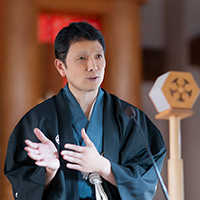
Monthly Sermon

November 22, 2025 (Tenrikyo 188)
Honjima Grand Church Monthly Service Sermon

“Let us sow seeds of sincerity at Jiba”

Rev. Shigeharu Yokozeki
Honjima Grand Church Associate Board Member

Rev.yokozekiShigeharu

(Summary)

A bitter winter season is coming up. In the Anecdotes of Oyasama, there are anecdotes that severe cold of winter is depicted, such as Rev. Rin Masui’s “A Snowy Day” and Rev. Tokichi Izumita’s “Smoothed Out Gently.” But among such stories of our predecessors who endured hardships in the cold winter, the story of Oyasama’s last imprisonment at Ichinomoto Police Station in 1886, when Oyasama was 89 years old, touches our hearts the most. Please allow me to read a few pages.

*Read pages 205 to 211 of The Life of Oyasama, Foundress of Tenrikyo, Chapter Nine “The Hardships of Oyasama.”

The reason Oyasama went through the hardships of being taken into custody at the police station was none other than from Her desire to have us human beings lead the Joyous Life as soon as possible. In order to realize this goal, the completion of the Service was indispensable, but when people performed the service, it led to the police to come and take Oyasama into custody.

The Chapter Ten of The Life of Oyasama, Foundress of Tenrikyo, “The Portals Opened,” illustrates Oyasama, Who desired to save the world by completing the Service even a day sooner, and the anguish and inner conflict of the early followers who, out of their concerns for Oyasama’s safety and well-being, could not perform the Service. Further, the Divine Model of Oyasama up to January 26, 1887, the day when Oyasama shortened Her term of life to open the portals to step out and level the ground, saying, “the Parent shortened Her life by twenty-five years to step out and save the world from now,” is described as well.

We are able to spend each day without inconvenience and continue to practice our faith without interference from the authorities or slander from the public. This is thanks to the hardships endured by Oyasama, the anguish and struggles of our predecessors, and the predecessors of the path who have continued the faith to this day, as recorded in the Life of Oyasama.

Oyasama’s 140th pre-anniversary activities, which began with the announcement of the Instruction Four by the Shinbashira, are now down to just two months.

In the Instruction Four, the Shinbashira states, “The period of ‘three years, one thousand days’ that leads up to an anniversary of Oyasama is a time for us to actively move forward on the path of single-hearted salvation by implementing the teachings with our sights set on the Divine Model.” As we have been carrying out our pre-anniversary activities over the past three years or so, I believe each of us has made the spiritual resolution to follow even 1/10,000 of the path of the Divine Model.

There is only a short time left in the pre-anniversary activity period. This month we will be holding the Shidokai Beseki Group Pilgrimage, and I believe that many people will return next year for the Oyasama’s 140th anniversary. One thing we would like to keep in mind during this time is to “return to Jiba'” as well as “sowing the seeds of sincerity at Jiba.”

This is a personal matter, but starting in April eight years ago, I served for about one year as a one-year-term instructor at the Spiritual Development Course at Church Headquarters.

This happened when I was talking with one of the homeroom instructors I met at that time. Without thinking too deeply, I casually said something like, “If we return to Jiba, we will receive the blessings.” But the instructor corrected me, saying, “That’s not correct. Jiba is a place to serve, to make effort in carrying out our duties, and to sow seeds of sincerity. Many people misunderstand this.”

At the time, I didn’t really understand what that meant, but looking back now, I realize it was a lesson with a profound meaning.

Jiba is the place where God the Parent first began the world and created human beings. It is also where the sacred name of God the Parent, Tenri-O-no-Mikoto, was bestowed, and where God resides. It is also the place where the Service for universal salvation is performed. When we make a pilgrimage back to Jiba, God the Parent and Oyasama will surely rejoice, saying, “Welcome home.” Even that alone is a great gift to take back with us.

However, what that instructor meant was that it is not enough just to make a pilgrimage to Jiba. Rather, we should take the opportunity to dedicate even one act of true sincerity there. I believe he was teaching me that this is what is essential in order for our hearts to be saved.

In the Mikagura-uta, we are taught,

As this Residence is the field of God, Every seed sown here will sprout.
(Mikagura-uta: Song Seven)

When you sow the seeds of sincerity at Jiba, and make efforts to return to Jiba, when those seeds that were planted will eventually sprout buds in the appropriate season and result in great blessings.

We are also taught in the Anecdotes of Oyasama,

“I am not sending you anywhere to learn, or inviting anyone to teach you. All things are to be learned in this Residence. There is nothing that can be learned from the world. Because it is first taught from this Residence, there is truth in what is learned.”
(Anecdotes of Oyasama: #53 From This Residence)

The Jiba is a place where there are many opportunities to learn the teachings, starting with the Basic Course, the Spiritual Development Course, the Minister Qualification Courses, and Tenri Seminary School is also located in Tenri.

In the Spiritual Development Course, it is always taught that “This (Jiba) is where you learn the way to live the Joyous Life.” And in the Junior Seminary and the Graduate Seminary, the teachings are taught more in depth.

Jiba is a place where those who have studied there, those who have sown their seeds of sincerity there, return to their own districts and locales to practice living the Joyous Life. These people also invite as many people as possible to return to Jiba so that they may learn the teachings of the Path and how to live the Joyous Life.

There are two months left till the 140th Anniversary of Oyasama and the activities leading up to it are reaching their climax. Along with talking to more people and bringing them back to Jiba, it is also important to invite people who will sow seeds of sincerity in Jiba and others who will study there.

In order to invite people without missing the seasonable time, I pledge to do my best to conduct my anniversary activities while always keeping the aforementioned in mind, so that I can have many people return to Jiba on the day of the 140th Anniversary and bring joy to Oyasama. With this, I would like to close my talk for today.

(Edited by Honjima Tsushin Editorial Staff)
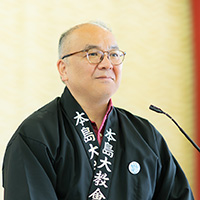
Greeting

October 22, 2025 (Tenrikyo 188)
Head Ministers’ Meeting

“From Parent to Child, From Child to Grandchild, Let Us Pass Down the Faith”

Rev. Kanta Katayama
Honjima Grand Church Head Minister

Rev.KatayamaKanta

(Summary)

I would like to report three things along with a request from myself.

The Grand Church Mission Visit for next year will be conducted over three months from April to June. Although they are usually held from January, next year, they will begin in April so that we may carry out the mission visits in accord with the words we will receive from the Shinbashira on the day of the 140th Anniversary of Oyasama. This will apply both domestically and overseas. Thank you for your understanding and cooperation.

Next, in today’s sermon delivered by Rev. Yoichiro Miyamori, we were taught about the final preparations leading up to the anniversary of Oyasama as well as the important ways of using our minds as Yoboku in our future journey. A summary of the sermon will be published in the Honjima Newsletter, so I hope we can study it repeatedly and make it a guide for our own personal course of faith.

And next month, the Shidokai Besseki Group Pilgrimage to Jiba will be held on November 30. Let us learn from the faithful attitude of Kekko Gen-san, bring many people to Jiba, the home of all humankind, have them attend the Besseki lecture, and sincerely nurture them to become Yoboku who can move forward toward the Joyous Life.

Lastly, next year will mark 40 years since the passing of Rev. Noboru Katayama, the fourth Head Minister of Honjima Grand Church. The Grand Church is planning to conduct the 40th Memorial Service on October 21 of next year.

Those who are younger than 40 years old have never had the opportunity to meet Rev. Noboru in person. Therefore, we would like to make this memorial anniversary a time to convey to those who do not know his faith convictions and guiding principles upheld by the Fourth Head Minister. We would like to make it an anniversary where we can pass it down from parents to children, and from children to grandchildren.

This concludes my remarks. Thank you very much.

(Edited by Honjima Tsushin Editorial Staff)
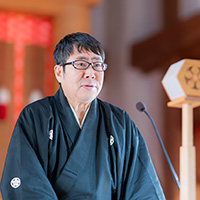
Monthly Sermon

October 22, 2025 (Tenrikyo 188)
Honjima Grand Church Autumn Grand Service Sermon

“Joyous acceptance is sincerity. Sincerity is the principle of heaven.” Let us connect ourselves to Jiba.

Rev. Yoichiro Miyamori
Honjima Grand church counselor

Rev.miyamoriYoichiro

(Summary)

We have arrived now with only three months remaining until Oyasama’s 140th Anniversary. How quickly time has passed since three years ago, when the Shinbashira announced the Instruction Four to initiate the “three years, one thousand days” efforts towards Oyasama’s Anniversary. Three years seems to have passed by before we knew it. We are now at the final three months.

I’d like to ask if you all recall the resolutions you had made in the beginning. I wonder if there were times where they just slipped your mind. Or perhaps you feel you made some progress or made a fairly good amount of effort towards your resolutions, while others may feel that it has not been going so well. We still have three months left. I urge you to follow through with a final determined effort.

We are taught the teaching of the “Eight Dusts of the Mind.”

In the Besseki lecture, it reads,

“God the Parent refers to our misunderstanding of the truth as dust so that we can easily understand the concept.”
(Trial translation for this script)

Further, it states,

“Although particles of dust are minute and can be blown away just by puff of air, if you allow them to accumulate, they will accumulate quickly before you know it, to the point where it becomes difficult to make it as clean as its original state, no matter how hard you sweep or wipe them away. Similarly, even though God the Parent allows us to use our minds as our own, if we use them in a self-centered way that does not accord with the will of God the Parent, then we will end up experiencing problems and sufferings due to the laws of nature. If we understand this and correct our mistaken minds sooner, using God’s teachings as our guiding principle, our minds will become clear and our bodies will be healthy.
(Trial translation for this script)

The dusts of the mind are “miserliness,” “covetousness,” “hatred,” “self-love,” “grudge-bearing,” “anger,” “greed,” and “arrogance,” but I believe it would be easier to understand the concept when we ponder the opposites of what they are.

“Miserliness” includes “begrudging giving our services in mind or body; begrudging paying an imposed charge; begrudging fulfilling our responsibilities to the world, or to others; begrudging returning things borrowed; and sitting back while others perform our unpleasant work—all these are considered to be the dust.”

The opposite of this dust would be to do everything we can generously and willingly. Thus, it would be good if we could do things with the mind of hinokishin.

“Covetousness” includes “craving for money without putting in any mental or physical effort to earn it; desiring good clothes or good food beyond what is appropriate or fair; and desiring more and more, although what we have is enough.”

The opposite of this would be to be contented with what we have right now. To be contented, we should try to practice the mind of joyous acceptance.

“Hatred” is “taking offense at someone’s advice given in good faith and feeling animosity toward this person, hating adopted children, hating daughter-in-law and gossiping and laughing maliciously at someone.” Interestingly parents-in-law are not included in here. Assuming it means not to hate young people like adopted children and daughters-in-law. The opposite of hatred is to cherish, love and caring affectionately.

In the Ofudesaki we are taught,

All children in the world are equally dear to Me.
Though there is no discrimination whatsoever. (XV:69)

To Tsukihi, everyone is My child, whoever you may be.
Though I have been watching over you with nothing but love, (XII:88)

“All of you may be wondering why I say such things.
It is from My love for my children. (XI:47)

For all of you children in the world,
there is only love in the thoughts of Tsukihi. (XVII:49)

The mind of God is loving the children affectionately. Hating others, whom God loves caringly, is using the mind completely opposite of God’s heart.

Let’s say your kids are having a fight. For some reasons, older brother is being really angry at his younger brother. How do parents react about it? They will probably say, “stop it,” to their older one. They will say, “please be patient with your younger brother.” This is the parental heart. Telling “please be patient” to whom will likely understand is the mind of the parent.

Next, let’s talk about “self-love.” It is a bit different “love” from what I talked about earlier. Self-love, in other words, it is the mind of selfishness. Caring only about ourselves, forgetting others and the mind only thinks about one’s family and themselves. The mind that is opposite from this is the mind of thoughtfulness and the mind that cares others compassionately.

The dust of “grudge-bearing” includes “bearing ill will toward others, claiming they have caused us to lose face or interfered with our attempt to gain what we desire or taking offense at some remark they made. In all matters, bearing ill will without looking at our own lack of wisdom, strength, or merit is dust. It is important to reflect critically on ourselves before getting caught up in the feeling of ill will toward others.” This is said to be the dust of grudge-bearing.

Suffering comes from your own mind.
So you should reproach yourself. (Mikagura-Uta: Song Ten)

Therefore, one must reproach oneself instead of bearing grudge against others.

What is the opposite of grudge-bearing? I believe that it is to forgive. As the elder brother, forgive the younger sibling. This should be the way one uses their mind. However, it is difficult to do that in the family. The father has a hard time forgiving the son. Even between husband and wife; if it is something the lady next door is doing, it doesn’t make you irritated, but if your wife is doing the same thing, it makes you angry. These things happen. Forgive. It is very important.

The dust of “anger” includes “becoming angry just because someone has said something we find disagreeable or because someone has, in our own view, done something wrong. Anger also arises when we insist on making our own opinions heard without trying to understand others’ points of view.” The opposite of anger is a calm mind, a satisfied mind; in other words, it is a mind of joyous perception. It is important to be able to fully perceive with a mind of joy.

The seventh dust of “greed” includes “desiring to have more than others and take as much as possible by any means—whether by giving short measure, by misappropriating what belongs to others, or by engaging in profiteering. Also included in the dust of greed is succumbing to lust.” The opposite of greed is honorable modesty. One must keep their mind pure. This is the mind of joyous perception.

The eighth dust, “arrogance,” includes “being puffed up with self-importance; being domineering; looking down on others and trampling on others by abusing our wealth or power; flattering our superiors while being cruel to our subordinates; holding others in contempt by boasting that we are knowledgeable; pretending to know what we really do not; and finding fault with others.” This, we are taught, is the dust of arrogance.

The opposite of arrogance is modesty. A mind that is humble. A humble use of mind, I think, is a mind of joyous perception.

Thinking of the opposites of the Eight Dusts I just mentioned, we realize that the most important thing for us is to follow the path while firmly settling the mind of joyous acceptance daily. I think the basis of salvation lies where you live every day by accepting things joyously, “This is good enough for me. I am very thankful.” People will naturally come to those who accepts things joyfully.

It may take time to become a person who exemplifies the truth of the teachings and a person who accepts things joyously. It may take a while for others to understand. Oyasama went through the path for 50 years. I think we, too, should strive each day to practice the mind of joyous acceptance and devote ourselves to help others be saved.

In the Divine Directions given on May 13, 1890, we are taught:

There are many who think, “why, after all this effort I have put into my faith....” This will not do. Sincerity is lacking. There is nothing to accept. […] If you react with dissatisfaction, everything will become dissatisfying to you. There is nothing to accept other than joyous acceptance. […] Joyous acceptance is sincerity. Sincerity is the principle of heaven. Being the principle of heaven, sincerity is surpassed by nothing. Please understand this principle.
(Osashizu: May 13, 1890)

Many people may think, “I am doing my best. Why does God not understand me? How come I don’t I receive blessings?” Such attitude will not do. There is no sincerity. If you think, “Why?” it shows a lack of sincerity, and God says it cannot be accepted.

If you react with dissatisfaction, things will become dissatisfying. The opposite of joyous acceptance is dissatisfaction. God says you will become more dissatisfied.

Sincerity is the mind of helping others be saved. If you think, “I have to help this person be saved,” you will be able to accept things joyously. Joyous acceptance is sincerity—only joyous acceptance is the foundation of helping others be saved. It is said that the mind of helping others be saved is the foundation of joyous acceptance. We should settle joyous acceptance in our minds and diligently help others attain salvation. Furthermore, it is said that while saving others, we will realize that “this person will not be saved unless I practice joyous acceptance.”

In the Story of Creation, it is stated that “God the Parent consumed all the loaches in the muddy ocean, tested the flavors of their nature, and made them the seeds for human beings.”

We are taught that the loaches were the seeds for human beings.

What is the nature of a loach? It lives in the muddy waters. Typically, if fish live in the muddy waters, naturally mud will get into their stomachs. If you fish carp, you have to expel the mud before consuming it.

Incidentally, although the loach goes into mud, mud does not get into its stomach. This is very interesting.

Also, it is said that loaches are mild-mannered and gentle. They don’t attack other fish. If you raise them in an aquarium, the water becomes clean. They clean the tank by eating the remaining filth.

Further, loaches live at the bottom. Even if the water dries up, they dig into the mud. When it rains and there is enough water, they will come out of the mud. This is essentially, a loach. A humble heart, warm, kind, and has the hinokishin spirit that cleans things that are dirty. This is the seed of human beings.

The place that the loaches return to is the Jiba. Let us all return to our birthplace and connect our hearts to the Jiba. At Jiba, we can find peace of mind. This is where you will find the warmth of the Parent. The Jiba is the origin of salvation.

We always live every day with warm, gentle, and humble heart and accept things joyously. Convey other people that we have characteristics of a loach and invite them to return to Jiba together. So that we will be able to receive the blessings of God the Parent and will be able to touch the heart of Oyasama, please allow me urge you to connect your heart to Jiba. With these remarks, I would like to end my talk today.

In three months, we will observe the 140th Anniversary of Oyasama. Let us go through the next three months in a way that Oyasama will say, “Job well done.”

Thank you for your kind attention.

(Edited by Honjima Tsushin Editorial Staff)

PageTopへ戻る